Video Ads for Local Service Businesses: Planning and Testing
Start With the Service Decision
A local-service video ad should help a qualified prospect recognize a problem, understand the approach, assess trust, and take an appropriate next step. The ideal style is not determined by whether the market is urban, suburban, affluent, or “high-end.” It depends on the service, audience, risk, proof, placement, and sales process.
Raw founder footage, customer demonstrations, polished production, animation, and static creative can all work. Treat each as a hypothesis rather than a universal winner.
A Flexible Problem–Solution–Proof Structure
- Opening: Identify the audience, situation, or useful question quickly enough for the placement.
- Problem: Describe the real consequence without exaggerating fear or urgency.
- Approach: Show the process, team, environment, or result where permission and policy allow.
- Proof: Use genuine reviews, credentials, demonstrations, or case evidence with the required disclosures.
- Next step: Match the CTA to intent—learn, compare, request an estimate, check availability, call, or book.
Choose Talent and Production Intentionally
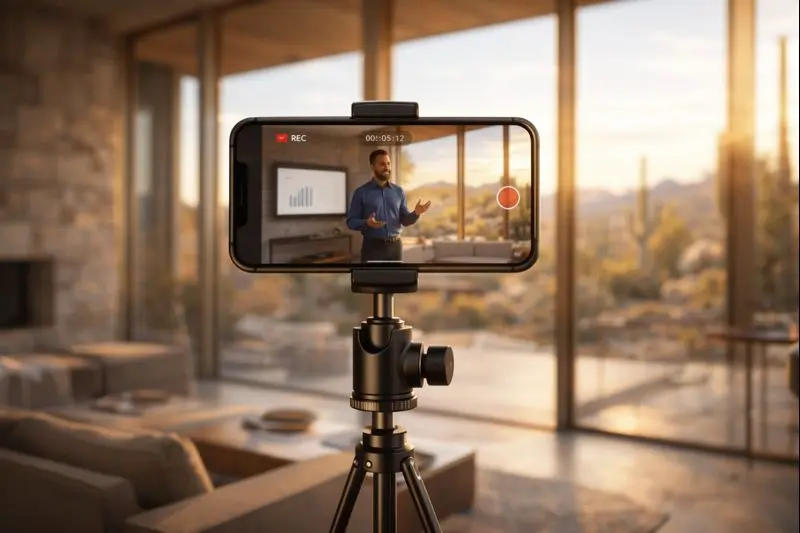
A founder or subject-matter expert can demonstrate expertise directly, while a customer, technician, narrator, or visual demonstration may be more credible for other services. Stock footage is useful when it accurately supports context, but it should not imply a local team, customer, facility, or result that is not real.
Compare lean and polished production against the same offer and audience. Include production cost and reuse potential when judging performance.
Design for Placement and Accessibility
- Create vertical, square, or landscape versions based on actual placements rather than cropping blindly.
- Keep essential text inside safe areas and provide accurate captions.
- Make the offer understandable without sound while still mixing speech and music clearly.
- Avoid rapid flashing, unreadable overlays, and visual proof that disappears before it can be understood.
Use Local Context Only When It Is Genuine
Real team members, projects, service areas, climate considerations, regulations, and customer questions can make creative locally relevant. Do not manufacture neighborhood familiarity or make assumptions about income, lifestyle, or buying behavior from a location name.
Connect the Ad to the Lead Journey
The landing page should continue the service, location, proof, availability, and next step promised by the video. Track clicks, landing-page views, calls, form starts, bookings, qualified leads, sales outcomes, and reasons for disqualification.
For regulated or sensitive services, review licensing, claims, testimonials, targeting, privacy, and platform policy before launch.
Build a Useful Test Matrix
Test one meaningful variable at a time where feasible: expert versus demonstration, problem versus process hook, short versus longer explanation, proof type, offer, or CTA. Define the minimum evidence, guardrails, and stop condition before spending.
Powerhouse Media's performance marketing services connect video creative to landing pages, tracking, lead qualification, and revenue outcomes.
Related Insights
Continue exploring Paid Ads
Ready to apply this to your brand?
We partner with brands looking to scale profitably.
Apply for a strategy call