YouTube Ads for High-Ticket Coaching: VSL Funnel Framework
Introduction: The High-Ticket Lead Gen Crisis
If you're selling a coaching program or consulting service above $3,000, you've likely hit the "Meta Ceiling." You can generate cheap leads—$5 or $10 opt-ins on Facebook—but your sales team is burning out calling prospects who can't afford your offer or don't remember signing up.
This guide addresses a common high-ticket acquisition problem: a pipeline can contain plenty of inexpensive leads while producing too few qualified sales conversations.
The framework shifts the campaign from interruption-led lead capture toward intent-aware YouTube ads, a Video Sales Letter (VSL), and an application that filters for fit before a call is booked.
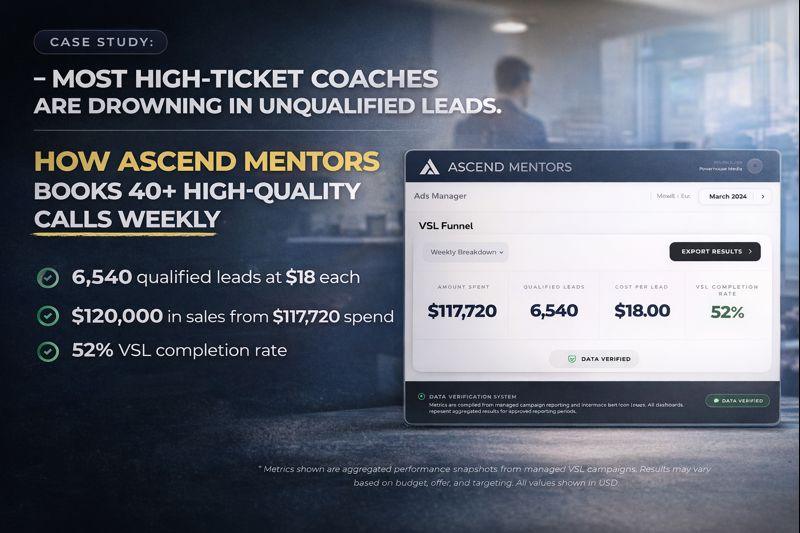
Editorial note: this page is a campaign framework, not a documented client case study. The repository does not contain the source exports, CRM records, attribution definitions, or client approval required to substantiate the exact performance claims previously published here.
The Core Strategy: Why YouTube Beats Meta for High-Ticket
Most agencies treat all traffic sources as equal. They aren't. The mindset of a user scrolling Instagram is "entertain me." The mindset of a user on YouTube is "educate me" or "solve my problem."
For high-ticket offers, this intent difference is critical.
A useful audit compares Cost Per Lead (CPL) with qualified-call rate, sales opportunity rate, Cost Per Acquisition (CPA), and collected revenue. A higher CPL can still be more efficient when the downstream conversion rate and customer value improve.
Why this matters in 2026: As AI floods social feeds with generic content, human trust is at an all-time premium. Video ads—specifically long-form ads (2+ minutes) on YouTube—allow you to build authority and trust before asking for the click. We weren't just asking for an email; we were auditioning for the role of trusted advisor.
The "Anti-Hype" Creative Framework
The most common mistake in coaching ads is the "Lifestyle Hook"—rented exotic cars, beaches, and stacks of cash. In 2026, the market is immune to this. It signals "scam" instantly.
An "Anti-Hype" Framework can use deliberately stripped-back creative:
- Visuals: Just the founder, a high-quality camera, and a whiteboard. No B-roll, no music swells.
- The Hook: We led with a specific, painful industry truth. "Most agency owners stay stuck at $20k/month because they haven't solved their delivery bottleneck, not their sales bottleneck."
- The Argument: The ad didn't just tease a solution; it taught a framework. We gave away the "what" and sold the "how."
This approach filtered out "opportunity seekers" (who want effective-looking shortcuts) and attracted "business builders" (who recognized the validity of the problem being described).
Funnel Architecture: The 3-Step VSL Filter
We replaced the traditional "Webinar Funnel" (which has low attendance rates in 2026) with a streamlined VSL Funnel. Speed to consumption was the priority.
Step 1: The "No-Distraction" Landing Page
The landing page had zero navigation links. Just a headline repeating the ad's promise ("How to Scale to $100k/mo Without Delivery Chaos") and a video player. No lengthy copy block. If they clicked the ad, they wanted the video. We gave it to them immediately.
Step 2: The 12-Minute VSL
The Video Sales Letter followed a strict psychological structure:
- Minute 0-2: Validated the viewer's pain (Delivery bottlenecks).
- Minute 2-5: Deconstructed why old solutions (hiring more VAs) fail.
- Minute 5-9: Introduced the offer's distinct mechanism and supporting evidence.
- Minute 9-12: Social proof and the "Call to Strategy" (Booking).
Step 3: The "Friction" Application
We intentionally added friction. After clicking "Book a Call," prospects had to complete a 12-question application. Questions like "What is your current monthly revenue?" and "Are you prepared to invest low-five figures in your growth?" scared away tire-kickers. If someone filled this out, they were ready to buy.
How to Measure the Funnel
Define the measurement chain before launch: ad spend, qualified video visits, applications started, completed applications, qualified calls, attended calls, opportunities, collected revenue, refunds, and contribution margin. Record the attribution window and distinguish platform-reported conversions from CRM-confirmed outcomes.
Common Misinterpretations (Why You Might Fail)
If you copy this funnel but fail to execute the nuance, it will fail. Here are the top three reasons we see this strategy flop:
- Weak Offer Positioning: If your offer is generic ("I help you get leads"), YouTube audiences will ignore you. You must target a specific mechanism ("I help digital agencies install automated fulfillment systems"). Specificity sells.
- Boring Ad Hooks: You cannot start a video with your logo. You have 5 seconds to earn the next minute. You must open with a pattern interrupt—a visual or statement that breaks the viewer's scroll trance.
- Low-Ticket Mindset: Do not try to sell a $5,000 program like a $47 course. Don't use urgency countdown timers or fake scarcity. Respect the buyer's intelligence.
How to Implement This Strategy
If you are a high-ticket coach or consultant looking to replicate these results, start here:
1. Audit Your "Message-Market Fit": Before spending a dollar on ads, call 10 past clients. Ask them exactly why they bought and what problem they were desperate to solve. Use their words in your ad script.
2. Film "ugly" ads first: Don't hire a production crew yet. Film 3-5 variations of your script on your iPhone or a simple DSLR. Audio quality matters; video production value does not. Let the market decide which message wins.
3. Build the "Filter" Funnel: Use software like GoHighLevel or ClickFunnels to build a simple page: Headline + VSL Video + Button. That's it. Complexity kills conversion.
Conclusion: The Era of "Brand-Formance"
High-ticket performance marketing depends on trust as well as lead capture. A YouTube VSL is one testable path, not a guaranteed result; its value should be judged against qualified pipeline, acquisition cost, collected revenue, and margin.
If you are ready to test a more measurable client-acquisition system, connect the creative, VSL, application, CRM, and revenue reporting before increasing spend.
Related Insights
Continue exploring Paid Ads
Ready to apply this to your brand?
We partner with brands looking to scale profitably.
Apply for a strategy call