Google and Meta Ads for SaaS: A Dual-Channel Growth Framework
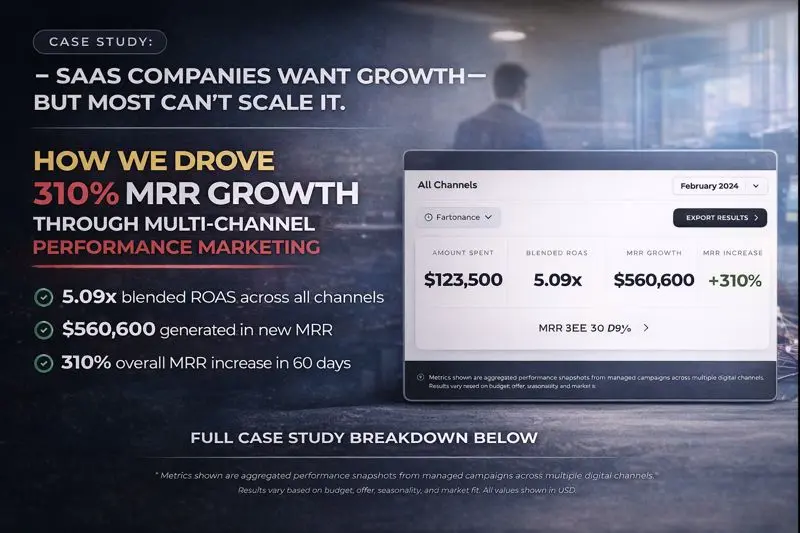
Introduction: The "Founder-Led Sales" Bottleneck
Every SaaS company hits the same wall. You hustle your way to $10k or $20k MRR through founder sales, Y-Combinator referrals, and cold outreach. But then growth stalls.
You can't clone the founder. To scale from $20k to $80k+ MRR, you need a machine—a predictable acquisition system that turns strangers into paid users without you having to get on a Zoom call.
This framework is designed for SaaS teams that rely heavily on founder-led outreach and need a measurable path toward paid acquisition.
Editorial note: this page is a strategic example, not a documented client case study. Exact trial, MRR, ARR, and channel-performance claims were removed because supporting source exports, cohort definitions, CRM records, and client approval are not present in the repository.
The Strategy: Why "Single Channel" Kills Growth
Most SaaS founders make a fatal binary choice: "Should we do Google Ads OR Facebook Ads?"
This is the wrong question. They serve completely different functions in the B2B buyer journey.
- Google Ads (Harvesting Demand): Captures people actively searching for "Workflow Automation Software." These leads are expensive but converting NOW.
- Meta Ads (Generating Demand): Targets people who match your Ideal Customer Profile (ICP) but don't know you exist. These leads are cheaper but need education.
The Fix: The Dual-Funnel Architecture.
The dual-funnel model uses Google Search to capture high-intent traffic and retargeting on relevant paid-social channels to reinforce product understanding. Each channel needs its own audience, message, landing-page path, and attribution role.
Creative Strategy: "Ugly" Demos Outperform Glossy Ads
The biggest mistake B2B SaaS companies make is using "Corporate Memphis" art—those generic vector illustrations of blue people holding giants phones. It conveys zero information.
A product-led creative strategy prioritizes useful demonstrations over generic vector art.
We ran 60-second "Raw Demos"—screen recordings of the software solving a specific, painful problem. No intro, no logo splash, just the cursor moving and a voiceover saying: "Stop manually copying data from HubSpot to Airtable. Watch this."
Test raw product demonstrations against polished brand creative, then compare qualified trial rate and pipeline quality rather than judging the winner by click-through rate alone.
Why? Because B2B buyers are skeptical. They want to see the UI. They want to know if it actually works before they click.
Landing Page Engineering: Matching Context
We stopped sending traffic to the Homepage. Homepages are for navigation; Landing Pages are for conversion.
Build distinct landing page experiences for distinct intent:
1. The "Competitor vs." Page (For Google Traffic)
Someone searching for an alternative should see a fair, evidence-based comparison page that addresses switching criteria instead of a generic homepage.
2. The "Use Case" Page (For Meta Traffic)
Paid-social traffic should land on an industry or use-case page that demonstrates relevant workflows and templates. Measure whether that added relevance improves qualified trials and revenue, not CPC in isolation.
How to Measure a Dual-Channel SaaS System
Report spend and conversion volume by channel and campaign intent. Connect trials to activation, product-qualified leads, paid conversion, retained MRR, gross margin, customer-acquisition cost, and payback period. Cohort dates, attribution windows, cancellations, discounts, and assisted conversions should be stated before publishing a performance claim.
Common SaaS Advertising Mistakes
- Gating the Product: If you are under $5M ARR, do not force people to "Book a Demo" to see the tool. Give them a Free Trial or an Interactive Demo. Friction kills PLG (Product-Led Growth).
- Ignoring Bing: Yes, Bing. For B2B SaaS, audiences on Desktop Windows machines are often corporate buyers. We moved 15% of budget to Microsoft Ads and saw a 30% lower CPA than Google.
- Retargeting with "Benefits": They already know the benefits. Retarget with Social Proof. Show logos, G2 reviews, and testimonials. They need trust, not feature lists.
Conclusion: Predictable Revenue
Paid acquisition can complement founder-led sales when Google and paid social have distinct jobs and both connect to product and revenue data. Scale only after a cohort demonstrates sustainable acquisition economics.
Related Insights
Continue exploring Paid Ads
Ready to apply this to your brand?
We partner with brands looking to scale profitably.
Apply for a strategy call