Hyperlocal Meta Ads for Real Estate: Lead Qualification Framework
Introduction: The "Zillow Lead" Trap
If you're a real estate agent in a competitive market like Denver, you know the pain of "Internet Leads." You buy them from Zillow or Realtor.com, only to find out that the same lead has been sold to three other agents. You call them within 5 seconds, but they're already annoyed.
A hyperlocal paid-social campaign can give a real estate team an owned alternative to shared portal leads, but lead quality depends on the offer, audience rules, qualification, consent, and follow-up.
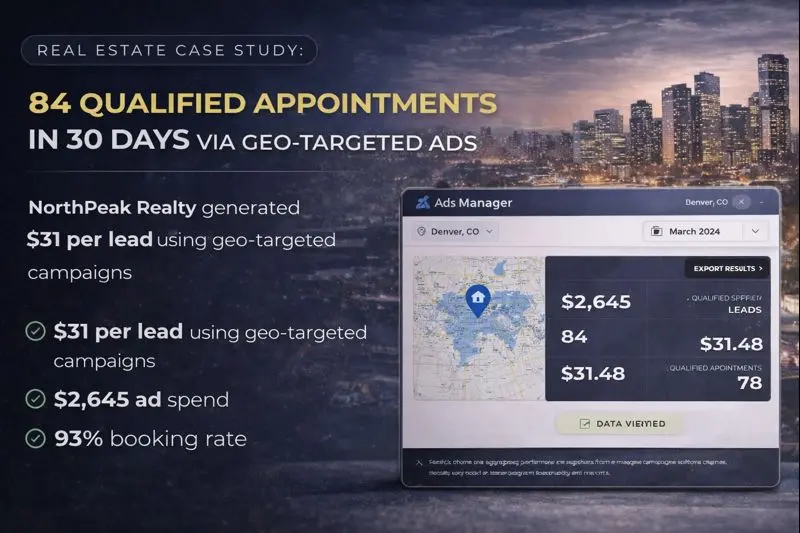
Editorial note: this page is a campaign framework, not a documented client case study. Exact spend, lead, appointment, contract, and commission claims were removed because the repository does not contain the platform export, CRM records, attribution definitions, or client approval needed to verify them.
The Strategy: Why Broad Targeting Fails in Real Estate
Most real estate ads fail because they try to sell a house to everyone. They target "People interested in Real Estate" within a 25-mile radius. This is a waste of money.
Real estate is hyper-local. A buyer looking in Wash Park isn't interested in a condo in RiNo. A seller in Cherry Hills doesn't care about your "Just Sold" in Aurora.
The Fix: Zip-Code Level Micro-Campaigns.
Test separate local audience groups only where the platform's housing-ad rules permit it. Creative can still address genuine neighborhood questions, but targeting, copy, and landing pages must comply with applicable housing and anti-discrimination requirements.
This specificity triggers the "Cocktail Party Effect"—when you hear your specific name (or neighborhood) mentioned, you pay attention.
Creative Shift: Value Over Ego
Many real estate ads focus on the agent rather than the prospective client's decision. Common examples include:
- "Look at this house I just sold!" (Who cares? You already got paid.)
- "I'm #1 in the market!" (Says who?)
- "Call me for a CMA!" (Boring.)
A Value Marketing approach can use short market-update videos in which an agent explains current, sourced local data:
- "Why inventory in 80206 is down 12% this month."
- "What the new interest rate hike means for Highlands Ranch buyers."
This positioned the agent as the Local Economist, not just another salesperson. It built trust before the click.
The "Native Booking" Funnel (Removing Website Friction)
For some campaigns, a native lead form can reduce friction compared with a general website. The right destination should be selected through testing and lead-quality measurement.
Websites are full of distractions. Listings, "About Us" pages, blog posts. We wanted one outcome: An Appointment.
We used Meta Instant Forms (Native Lead Forms). These forms load instantly inside Facebook/Instagram and pre-fill the user's name, email, and phone number from their profile. This reduces friction to near zero.
But doesn't that lead to low quality? Not if you add "Hurdle Questions."
Add concise qualifying questions that help the team understand timing and service fit:
- "When are you planning to move?" (0-3 months, 6+ months)
- "Are you pre-approved for a mortgage?" (Yes/No)
- "Do you have a home to sell first?"
These questions can improve context, but they do not guarantee high intent. Confirm quality through contact, appointment attendance, opportunity creation, and closed transactions.
How to Measure Lead Quality
Track spend, valid leads, contact rate, qualified conversations, appointments booked, appointments attended, represented clients, closed transactions, and attributable gross commission. State the reporting period, attribution window, duplicate-lead rules, cancellations, and whether revenue is estimated or collected.
Speed to Lead: The SMS Automation
Generating the lead is only 50% of the battle. The other 50% is speed.
Response time should be measured because delays can reduce contact rates. Where consent and local messaging rules permit it, automated acknowledgement can bridge the gap until a licensed team member responds.
When a lead came in at 8 PM, the AI instantly texted: enable "Hi [Name], saw you were interested in the LoDo market update. Are you looking to buy in the next 3 months?"
If the lead replies, the workflow can offer a compliant path to schedule with the team. Track opt-outs, delivery, response, booking, attendance, and human handoff quality.
Common Misinterpretations
- "Facebook leads are trash." No, unfiltered Facebook leads are trash. If you use custom qualifying questions, the quality rivals Zillow.
- "I need a big budget." A test budget should be based on local auction costs, expected conversion volume, sales capacity, and a predefined learning threshold.
- "I don't like being on camera." It's not about liking it; it's about trust. People hire people, not logos. A shaky iPhone video of you is better than a stock photo of a house.
Conclusion: Own Your Backyard
The days of being a "City-Wide" expert are ending. The agents winning in 2026 are the ones who own specific zip codes. By combining hyper-local creative with low-friction lead forms and instant follow-up, you can build a predictable pipeline that doesn't rely on Zillow selling you the same lead as your competitor.
Related Insights
Continue exploring Paid Ads
Ready to apply this to your brand?
We partner with brands looking to scale profitably.
Apply for a strategy call