Meta Catalog Ads for Skincare: Feed and Creative Framework
Introduction: The Death of "Interests" in Ecommerce
For a decade, the secret to Facebook Ads was "Interest Targeting." You targeted "Women aged 25-45 who like Sephora and Yoga."
In 2026, that strategy is dead. Privacy changes (iOS updates) killed it.
For a skincare advertiser, a scalable approach can combine Meta's automated sales campaigns with a clean catalog, useful creative, reliable conversion data, and sound product economics.
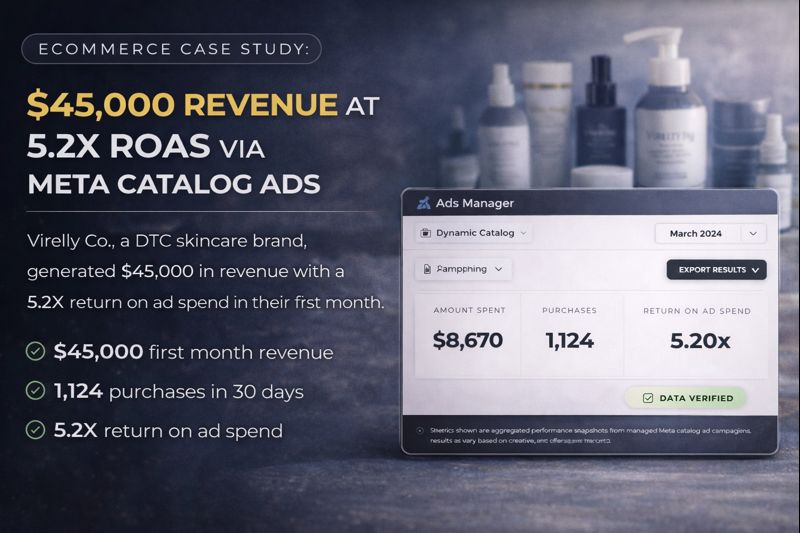
Editorial note: this page is a campaign framework, not a documented client case study. Exact revenue, ROAS, purchase, CAC, CPM, and timing claims were removed because the repository does not contain the platform and commerce exports, attribution definitions, refund data, or client approval needed to verify them.
The Strategy: Trusting the "Black Box" (Advantage+)
Meta's AI is smarter than any media buyer. It surveys millions of data points per second. Advantage+ Shopping Campaigns (ASC) essentially say to Meta: "Here is my product, here is my budget, find me buyers."
Many brand owners are scared of this lack of control. They want to turn the knobs themselves.
Automated campaign types still require human judgment. Consolidation may help when conversion volume is fragmented, but campaign structure should reflect budget, product margins, geography, creative volume, and measurement quality.
The "Data Layer": Feed Optimization
If you're running Catalog Ads (Dynamic Product Ads), your "Creative" is your "Product Feed."
Most brands simply sync Shopify to Meta and forget it. This is a mistake. The default feed images are often cropped weirdly or look boring.
Useful feed enhancement tests include:
- Custom Overlays: We added dynamic badges like "Best Seller" or "5-Star Rated" directly onto the product images in the feed.
- Price Striking: We ensured the "Compare At" price was visible to show the discount clearly.
- Lifestyle Switch: Instead of just white-background product shots, we tested feeds using lifestyle imagery (products in use) as the main image.
Creative Strategy: The "UGC Mashup"
While the Catalog Ads retargeted people, we needed to bring new people IN.
We didn't use polished studio ads. We used UGC Mashups.
A creator-led montage can compare multiple hooks and demonstrations within one fast-paced video. Every testimonial and product-performance claim must be genuine, permissioned, and supportable. One possible structure is:
- Hook: "Stop scrubbing your face raw." (Visual: Red, irritated skin).
- Solution: "This enzyme cleanser melts makeup in 10 seconds." (Visual: Satisfying melting effect).
- Proof: "My skin has never been this glowy." (Visual: Radiant after-shot).
Compare creator-led and studio creative using hold rate, qualified sessions, new-customer conversion, contribution margin, and incrementality where feasible—not CPM alone.
The "Fence-Sitter" Retargeting Layer
Many visitors leave without buying. A consent-aware retargeting plan can address unresolved product, trust, and price questions.
We built a 3-Step Retargeting Sequence:
- Day 1-3 (The "Hype" Phase): Show them the viral UGC video again. Remind them of the problem.
- Day 4-7 (The "Logic" Phase): Address ingredients, use, shipping, returns, and other decision criteria with fair, supportable comparisons.
- Day 8-14 (The "Offer" Phase): "Come back and get 10% off." This captures the price-sensitive buyers.
How to Measure Catalog Campaign Economics
Connect Meta spend to commerce-platform orders and reconciled revenue. Report new-customer CAC, contribution margin, average order value, refund and cancellation rate, repeat purchase, blended marketing efficiency, and incrementality where possible. State whether ROAS is platform-reported or based on reconciled revenue and define the attribution window.
Common Ecommerce Mistakes
- Ignoring unit economics: A low-priced product may still support paid acquisition when margin, repeat purchase, bundles, and retention make customer value sufficient. Model the economics before scaling.
- Changing creative without a decision rule: Set a minimum spend or conversion threshold that reflects the account's volume, then evaluate creative against downstream sales quality.
- Ugly Product Pages: You can have the best ads in the world, but if your mobile site loads slow or looks sketchy, they won't buy.
Conclusion: System Over Luck
Catalog campaign performance depends on the whole system: creative, feed quality, offer, product page, measurement, and product economics. Automated delivery can support that system, but it does not replace sound inputs or financial controls.
Related Insights
Continue exploring Paid Ads
Ready to apply this to your brand?
We partner with brands looking to scale profitably.
Apply for a strategy call