Lead Generation Funnel Framework: Demand, Proof, and Follow-Up
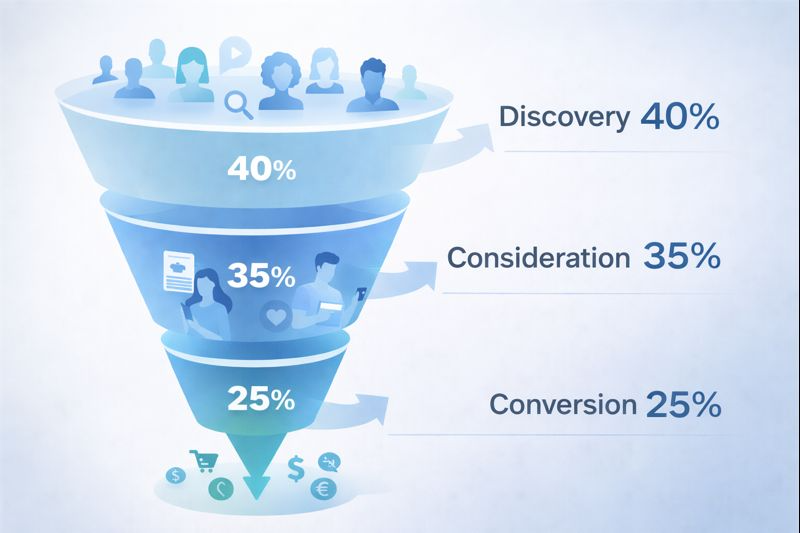
A Funnel Is a Measurement Model, Not a Prediction
Prospects rarely move through an identical sequence. They may discover a business through search, an ad, a referral, a community, or an article; compare proof across several visits; and convert through a different channel later.
A useful funnel documents the decisions a prospect needs to make, the assets that support each decision, and the events the business can measure. It should accommodate non-linear journeys without abandoning accountability.
1. Define the Qualified Outcome
Start with the commercial endpoint: qualified inquiry, attended consultation, sales opportunity, purchase, contract, or collected revenue. Define exclusions, duplicate handling, attribution window, and who owns each stage.
Work backward to the minimum information and commitment required at the first conversion. A high-friction consultation form may suit a complex service; a guide or calculator may be more appropriate when prospects need education first.
2. Separate Demand Capture From Demand Creation
- Demand capture: Search, directories, review platforms, referrals, and retargeting meet people already evaluating a problem or solution.
- Demand creation: Educational content, video, social, partnerships, and paid discovery help the right audience recognize a problem, approach, or category.
Low-volume, high-intent queries can be commercially valuable. Broader channels can expand reach, but they require stronger education and more careful qualification. Choose the mix from actual demand, sales cycle, budget, and measurement—not a fixed channel split.
3. Build Authority and Useful Proof
Answer technical and buying questions clearly. Use calculators, checklists, demonstrations, process explanations, documented case studies, reviews, credentials, and original insight where available. Local or community proof should be used only when genuine and permissioned.
Retargeting can distribute relevant proof to prior visitors, but it should respect consent, audience minimums, exclusions, and frequency controls.
4. Match the Landing Page to the Promise
The page should continue the same audience, problem, offer, proof, and next step presented upstream. Remove unrelated navigation only when a focused experience improves the task without withholding essential trust or policy information.
Measure click-to-page-view loss, mobile speed, form starts, validation errors, completions, calls, bookings, and qualified outcomes.
5. Design Qualification and Follow-Up
Ask only for information the team will use. Route leads by service, fit, urgency, geography, or value where appropriate. Confirm consent before automated email or messaging and provide clear human escalation.
Measure response time, contact rate, qualification, booking, attendance, opportunity creation, close rate, revenue, and reasons for loss. Faster follow-up may help, but speed cannot compensate for a weak offer or unqualified acquisition.
6. Measure the Journey Without Double Counting
Use platform reporting for delivery diagnostics, analytics for site behavior, and CRM or commerce data for qualified business outcomes. Reconcile sources rather than expecting them to match perfectly.
- Record first-touch and last-touch source where useful, but avoid presenting either as the full causal story.
- Use tagged links and consistent campaign naming.
- Import qualified or offline outcomes when consent and system design allow.
- Review assisted journeys and cohort performance before removing an upper-funnel channel.
Funnel QA Checklist
- Every channel and asset has a defined audience job.
- The landing-page promise matches the source message.
- Forms, calls, bookings, CRM stages, and revenue are testable.
- Lead ownership, response expectations, consent, and escalation are documented.
- Reporting separates raw leads from qualified and closed outcomes.
- Each experiment has a hypothesis, primary metric, guardrails, and stop condition.
Build a Measurable Lead System
Powerhouse Media's performance marketing services connect channel strategy, landing pages, tracking, lead handling, and revenue reporting into one operating model.
Related Insights
Continue exploring Paid Ads
Ready to apply this to your brand?
We partner with brands looking to scale profitably.
Apply for a strategy call