Mobile Detailing Marketing: Service Areas, Routing, and Booking
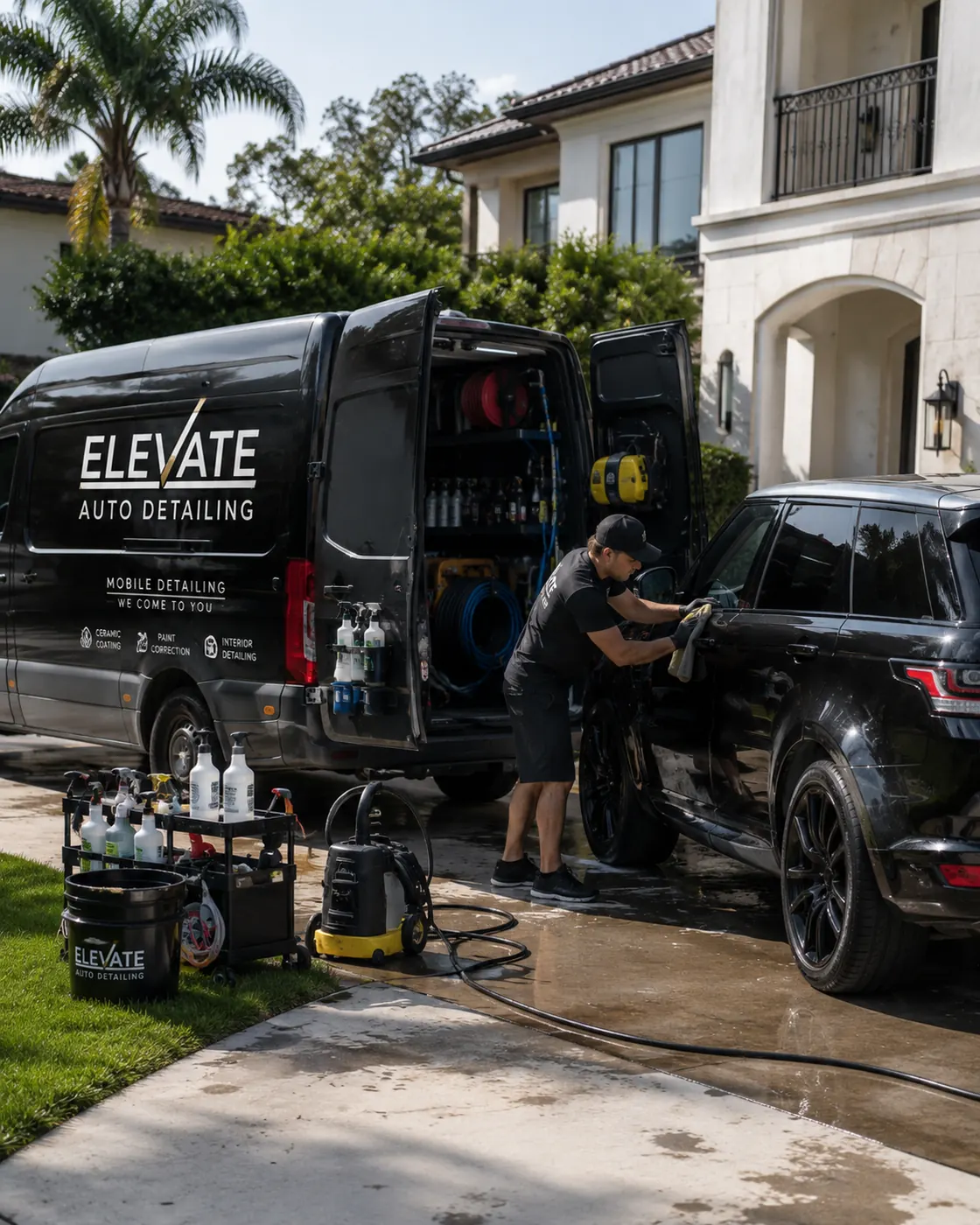
This guide covers the decisions unique to a mobile operator: where to accept work, how travel affects capacity, what local claims are legitimate, and how booking should qualify a job before a route is committed. Use the broader car detailing marketing guide for channel strategy and the new detailing business launch guide for an early-stage plan.
The Mobile Marketing Constraint Is Route Economics
A mobile detailer does not merely sell a service at a customer's address. Each booking consumes service time, travel time, setup and pack-down time, fuel or charging, vehicle and equipment capacity, and a weather or site-access risk. Marketing that creates distant, poorly qualified enquiries can make the calendar look busy while reducing completed-job contribution.
Define the operating promise before promoting it: services available on site, vehicle and condition limits, water and power requirements, suitable workspace, weather policy, building or parking permissions, travel fees, minimum job value, arrival window, cancellation terms, and areas genuinely served.
Mobile Service-Area Profitability Matrix
Build the service area from observed operations rather than drawing the largest possible radius. Review each zone at least monthly until travel and conversion patterns become stable.
| Zone measure | What to record | Decision it supports |
|---|---|---|
| Demand | Qualified enquiries, requested services, source, and day or time | Whether the zone produces work that fits the offer |
| Conversion | Estimates, bookings, cancellations, and completed jobs | Whether visibility becomes fulfilled revenue |
| Travel burden | Drive time, distance, tolls, parking, access delays, and dead mileage | Whether a travel fee, route day, or exclusion is needed |
| Job economics | Completed revenue minus labor, products, travel, payment, rework, and channel cost | Whether the zone contributes after fulfilment |
| Route compatibility | Jobs that can be grouped by geography, duration, equipment, and crew | Whether availability should be offered on selected days |
| Reliability | Weather disruption, site unsuitability, no-access events, and reschedules | Whether qualification or contingency terms need improvement |
Classify zones as core, scheduled-route, travel-fee, test, or unavailable. Do not advertise a larger area simply to collect more leads. A smaller service area with compatible jobs can produce better availability, punctuality, customer experience, and contribution.
Calculate Capacity Before Increasing Demand
Start with available crew hours, then subtract non-service work: driving, setup, pack-down, refilling, maintenance, quoting, customer communication, administration, and realistic disruption. Compare the remaining service hours with the duration and margin of each package.
If lead volume exceeds fulfilment capacity, tighten geography, minimum job value, qualification, or availability before buying more traffic. If capacity is unused, diagnose the actual gap—visibility, offer fit, trust, response time, price, booking friction, or an overly narrow schedule—rather than assuming another channel is the answer.
Build Legitimate Local Visibility
Represent the business according to the current rules of each platform and the locations where it genuinely operates. A service-area business should not present a virtual office, borrowed address, or unattended location as a customer-facing premises. Keep the business name, contact details, hours, service description, and availability accurate across the website and profiles.
Create a dedicated area page only when it helps a customer make a materially different decision. Useful local value can include verified availability, travel or minimum terms, access constraints, route days, services offered there, permission-based work examples, and locally relevant FAQs. Do not generate near-duplicate pages for every suburb, swap place names into a template, or claim an office where none exists.
For the complete local search workflow, including profile eligibility, reviews, citations, and measurement, use the auto detailing local SEO guide.
Mobile Booking Readiness Gate
Choose request-to-book or instant booking based on operational risk. Instant confirmation is appropriate only when the system can validate the required inputs and protect capacity. Higher-variance work may need photo review, a call, or an inspection before confirmation.
| Booking input | Why it matters | Possible routing rule |
|---|---|---|
| Exact service address or eligible zone | Confirms travel, access, fees, and route fit | Accept, apply disclosed travel terms, or request review |
| Vehicle and requested service | Sets time, products, equipment, and skill requirements | Show eligible packages or require an estimate |
| Condition and photographs | Identifies contamination, damage, scope, and unrealistic expectations | Confirm scope, revise estimate, or decline unsuitable work |
| Workspace, water, power, and permission | Determines whether the service can be performed safely and lawfully | Confirm self-contained capability or alternate location |
| Date, time window, and weather fallback | Protects route integrity and sets arrival expectations | Offer compatible slots and state rescheduling terms |
| Contact, consent, deposit, and cancellation | Supports confirmation and reduces avoidable failed visits | Send a clear summary and record acceptance |
Test the entire flow on a phone, including validation errors, confirmation messages, calendar entries, notifications, attribution, rescheduling, and cancellation. Do not promise same-day service, instant confirmation, or a precise arrival time unless operations can consistently deliver it.
Match Marketing to Mobile Service Fit
Every channel should use the same eligibility and service-area rules. Search campaigns can capture existing demand; permission-based before-and-after evidence can demonstrate onsite capability; community participation and partners can introduce the service locally. None is universally best. Compare qualified enquiries, bookings, completed jobs, travel burden, cancellations, rework, repeat work, and contribution by source and zone.
Ads and pages should explain the genuine convenience without hiding customer requirements. “We come to you” may still require suitable space, access, permission, weather conditions, or utilities. Claims such as “best,” “number one,” “no appointment needed,” or “available anywhere” require evidence or should not be used.
Mobile Detailer Operating and Marketing Audit
- Published service areas match real scheduling and fulfilment capacity
- Travel, setup, access, weather, and cancellation costs are reflected in eligibility and pricing
- No virtual, borrowed, or unattended address is represented as a staffed customer location
- Any area page contains useful, verified local information rather than a place-name substitution
- Booking captures the inputs required to qualify scope, site, route, and availability
- Website, profiles, ads, forms, calendar, and customer messages make the same promise
- Performance is evaluated through completed-job contribution, not leads or booked revenue alone
Frequently Asked Questions
Should a mobile detailer create a page for every city served?
No. Create an area page only when the business genuinely serves the area and can provide substantial, useful local information. A repeated template with only the city name changed creates little customer value and can weaken the site.
How large should a mobile detailing service area be?
There is no universal radius. Set the boundary from demand, travel time, route compatibility, completed-job contribution, access, capacity, and reliability. Test expansion one zone at a time and retain it only when the evidence supports it.
Should customers be able to book instantly?
Only when the system can verify service eligibility, address, vehicle, condition, site requirements, duration, price, and availability. Use a booking request or estimate path when those variables need human review.
Should mobile detailing cost more than shop-based detailing?
Price from the actual scope and economics of the business. Travel, setup, self-contained equipment, convenience, site risk, and route density may affect cost, but no universal percentage applies. State travel fees, minimums, inclusions, exclusions, and price factors clearly.
Conclusion
A durable mobile detailing marketing system begins with an operable promise. Define profitable zones, protect route capacity, publish only legitimate local information, qualify each site and service accurately, and measure completed work after fulfilment costs. Then expand demand only where the operation can deliver the advertised experience.
Related Resources
- Car Detailing Marketing Guide
- Auto Detailing Local SEO Guide
- How to Market a New Car Detailing Business From Scratch
- Car Detailing Lead System
- Before-and-After Proof Capture Guide
Need the service area, booking path, attribution, and channel economics reviewed together? Request a car detailing growth audit.
Car Detailing Marketing Cluster
Build the full detailing growth system
Ready to apply this to your brand?
We partner with brands looking to scale profitably.
Apply for a strategy call