Local SEO for Auto Detailers: A Google Maps Ranking Guide
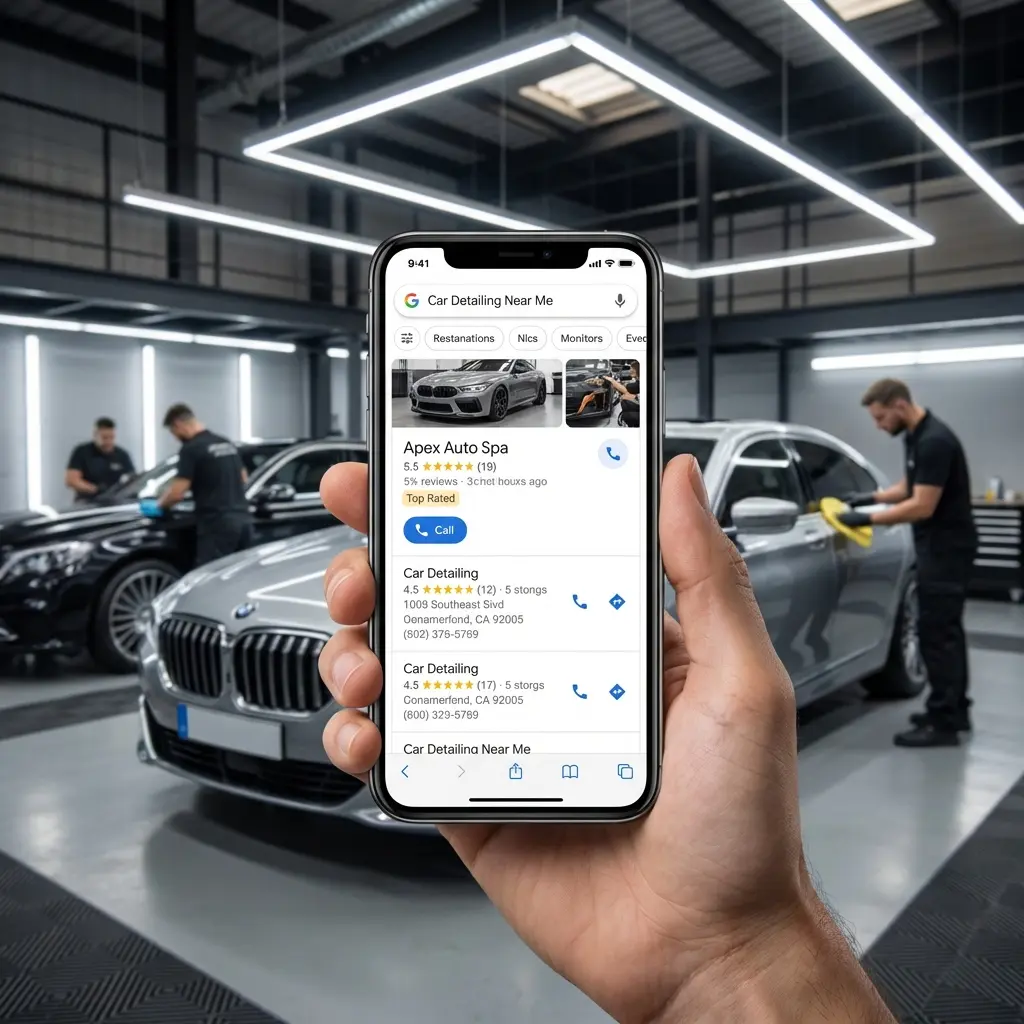
For the complete parent strategy, start with our car detailing marketing pillar guide. This article focuses on local seo for auto detailers and how it connects to lead generation, local visibility, paid traffic, and booked appointments.
What Is Local SEO and Why It's Non-Negotiable for Detailers
Local SEO is the practice of optimizing your online presence so your business appears prominently when people in your area search for your services. For auto detailers, the primary battleground is Google's local results — specifically the Map Pack and the organic listings below it.
Searches such as 'car detailer near me', 'mobile detailing [city]', and 'ceramic coating shop [city]' often come from people comparing nearby providers. Local visibility gives the business an opportunity to earn the call or booking; it does not guarantee that outcome without competitive proof and a usable conversion path.
How Google Describes Local Ranking
Google says local results are mainly determined by relevance, distance, and prominence. Relevance is how well the profile matches the search. Distance reflects the searcher's location. Prominence reflects how well known the business is, using signals that include links and reviews.
This creates a practical diagnostic order: verify that the profile accurately represents the business, confirm that categories and services match the real offer, review visibility from multiple points in the legitimate service area, and then strengthen trustworthy prominence signals.
Google Business Profile: The Cornerstone of Local Visibility
Your Google Business Profile (GBP) is the primary record you control for how the business appears in local Google experiences. It can surface in the Map Pack, Google Maps, and branded search features.
Start with complete, accurate information: business name, address, phone number, website, business hours, and service area. Choose the most relevant primary category — 'Auto Detailing Service' — and add secondary categories for specific services like ceramic coating or PPF.
Write a compelling business description (up to 750 characters) that naturally includes your primary keywords and city. This isn't just for customers — it's a relevance signal for Google.
GBP optimization priorities
- Verify your listing via postcard, phone, or video
- Add all services with descriptions and prices where applicable
- Upload truthful, well-lit exterior, interior, before-and-after, and team photos
- Enable messaging and set up an auto-response
- Add accurate service areas by city, postal code, or another supported area type
- Publish useful updates when there is something current to communicate
Building a Review Strategy That Compounds Over Time
Reviews can support both prominence and customer confidence. Google states that more reviews and positive ratings can help local ranking, but there is no universal review count that guarantees a Map Pack position.
Build a review collection system. After every completed job, send a follow-up via SMS or email — whichever channel your customer used to book. Include a direct Google review link. The easier you make it, the higher your conversion rate. Tools like Podium, NiceJob, or even a simple automated text message can automate this.
Ask consistently and make the process convenient, but never offer incentives for positive reviews or ask people without a genuine customer experience to post. Review growth should reflect real completed work.
Local Citations: Building Your Digital Footprint
A citation is any online mention of your business name, address, and phone number (NAP). Citations on authoritative directories signal to Google that your business is legitimate and locally relevant.
Priority citation sources for auto detailers include: Google Business Profile, Yelp, Facebook, Bing Places, Apple Maps, Yellow Pages, Foursquare, Angi, HomeAdvisor, BBB, and automotive-specific directories like Carwise and AutoServiceShops.
Consistency is paramount. Even minor differences — 'St' vs 'Street', a missing suite number, different phone format — can dilute your citation authority. Audit your existing citations quarterly using tools like BrightLocal or Whitespark.
Citation audit action plan
- Audit existing citations for NAP accuracy
- Claim and verify the top 15 general business directories
- Submit to 5–10 automotive-specific directories
- Seek accurate local mentions from relevant associations, suppliers, car clubs, and community organizations
Location Pages: Owning Multiple Service Areas
If you serve multiple cities or neighborhoods, create a dedicated landing page for each location. A single generic 'Service Areas' page wastes an enormous opportunity to rank in multiple geographic markets.
Each location page should be substantively unique. Include neighborhood-specific content: local landmarks, parking tips, common car conditions in that area (salt damage, sun exposure), or testimonials from customers in that city. Thin pages — just copy-pasted with the city name swapped — won't rank and may be penalized.
Internally link between location pages and your main service pages. This distributes authority throughout your site and helps Google understand your geographic relevance.
Only create pages for areas the business genuinely serves and can support with useful local information. A location page does not change the physical distance between the business and a searcher, and it should not imply a storefront that does not exist.
Local Link Building: The Authority Multiplier
Backlinks from other local websites are among the strongest local ranking signals. A link from your city's chamber of commerce, a local automotive blog, or a regional car club website tells Google you're genuinely embedded in your local area.
Target these link opportunities: local business directories, car show and event websites, charity sponsorships with web presence, local news coverage, automotive supplier partnerships, and cross-referrals from complementary businesses (auto repair shops, dealerships, paint shops).
Useful local coverage, supplier relationships, event participation, and genuine community partnerships can earn relevant links and referral traffic. Avoid paid link schemes or manufactured 'best of' placements that exist only to manipulate rankings.
On-Page Local SEO: Optimizing Your Website for Local Relevance
Your website needs to signal local relevance at every opportunity. Include your city and service area in your title tags, H1s, and naturally throughout your body copy. Don't stuff keywords — write naturally, but be specific.
Add your full NAP in the footer of every page. Embed a Google Map on your contact page. Create an 'About' page that mentions your city, how long you've been operating locally, and your community involvement. These on-page signals reinforce your local GBP and citation signals.
Implement LocalBusiness schema markup on your homepage. This structured data tells Google exactly what you are, where you are, what you do, and how to contact you. It's technical, but many website builders and plugins (Yoast, RankMath) make it manageable.
Tracking Local SEO Performance
You can't improve what you don't measure. Set up Google Search Console and connect it to your website. Monitor which queries bring you traffic, your average position, and click-through rates.
For Map Pack rankings specifically, use a local rank tracker. BrightLocal, LocalFalcon, and Whitespark all offer Map Pack rank tracking by keyword and location. Track your top 10 keywords across all cities you serve, weekly.
Key local SEO metrics to track: GBP views, calls from GBP, direction requests, website clicks from GBP, review count and rating trend, Map Pack ranking position, organic traffic from local keywords.
A 30-Day Map Visibility Plan
- Week 1 — accuracy: Verify ownership, business name, address or hidden-address setup, hours, phone, website, categories, services, and service areas.
- Week 2 — conversion proof: Add current, truthful photos; improve service descriptions; confirm booking and call links; and start a policy-compliant review request process.
- Week 3 — website alignment: Check NAP consistency, service-page relevance, mobile experience, internal links, and LocalBusiness structured data.
- Week 4 — local authority and measurement: Correct important citations, identify legitimate partnership opportunities, establish a geo-grid baseline, and record calls, bookings, and qualified leads.
Frequently Asked Questions
How long does it take to rank in the Google Map Pack?
There is no reliable universal timeline. Results depend on relevance, the searcher's distance, prominence, competition, profile history, and the quality of the business's wider web presence. Establish a baseline and evaluate sustained movement rather than promising a fixed date.
Can I rank in cities I don't have a physical address in?
A legitimate service-area business can have a verified profile and appear on Google without displaying a storefront address. It should use one profile for the area it serves, hide an address where customers are not received, and define accurate service areas. Creating virtual offices or fake locations violates Google's guidelines.
How many reviews do I need to rank in the Map Pack?
There is no required number. Compare the quality, quantity, and recency of genuine reviews within the actual local competitive set, then build a sustainable request process tied to completed work.
Should I respond to all Google reviews?
Yes. Responding to reviews signals engagement to Google and builds trust with potential customers. Keep positive review responses brief but personal. For negative reviews, acknowledge the issue professionally and offer to resolve it. Never argue publicly.
What's the difference between local SEO and regular SEO?
Regular SEO focuses on national or global keyword rankings. Local SEO targets geographically-specific searches ('detailing shop near me') and the Google Map Pack. Local SEO relies heavily on GBP optimization, citations, and reviews — not just website optimization.
Conclusion
Dominating local SEO isn't about any single tactic — it's about building a consistent, interconnected local presence. Optimize your Google Business Profile, collect reviews systematically, build citations, and create location-specific content on your website. Stack these signals, and your detailing business becomes the obvious choice in local search.
Related Resources
- Car Detailing Marketing Guide
- Google Business Profile for Car Detailers: Complete Optimization Guide
- SEO for Car Detailing Businesses: The Complete Guide to Ranking Higher on Google
Official Google Sources
- Google: Tips to improve local ranking
- Google: Guidelines for representing your business
- Google: Business Profiles for service businesses
- Google: Tips to get more reviews
Need the full SEO, ads, content, and booking system connected? Read the car detailing marketing pillar page or book a free Powerhouse Media growth audit.
Car Detailing Marketing Cluster
Build the full detailing growth system
Ready to apply this to your brand?
We partner with brands looking to scale profitably.
Apply for a strategy call