Car Detailing Website Design Best Practices
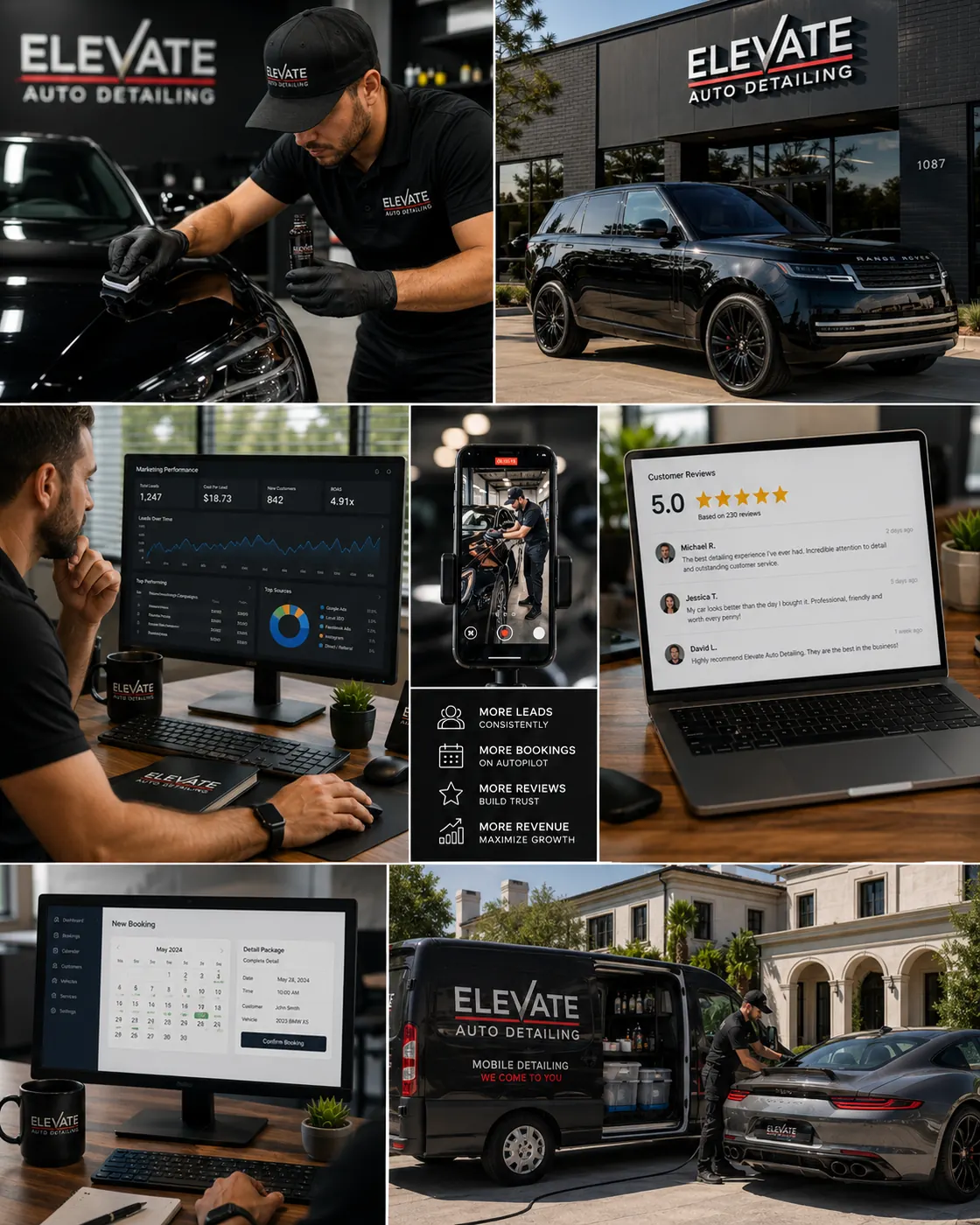
For the complete parent strategy, start with our car detailing marketing pillar guide. This article is a planning brief for a new detailing website or substantial rebuild: page architecture, requirements, acceptance criteria, and launch readiness. If an existing site already receives traffic but underperforms, start with the detailing website conversion audit before deciding to rebuild.
The Standard for a High-Converting Detailing Website
A great car detailing website does three things simultaneously: communicates clearly what you offer and where, builds trust through visual proof and social signals, and makes it frictionless to become a customer. Most detailing websites fail at at least one of these, leaving bookings on the table every day.
This guide covers the design and structural principles that differentiate converting detailing websites from ones that leak leads. Apply these to a new build or an existing site revision.
Choose the Site Architecture Before the Visual Design
Start with the services, locations, proof, and booking decisions the site must support. The following model is a planning baseline, not a requirement to create a page for every keyword variation.
| Business need | Recommended page | Required evidence or function |
|---|---|---|
| Explain the business | Homepage | Core offer, service area, differentiator, proof, and primary action |
| Sell a distinct service | One page per materially different service | Scope, process, suitability, price factors, examples, FAQs, and CTA |
| Build trust | About or proof page | Real team, facility, credentials, reviews, policies, and recent work |
| Serve genuine locations | Location page only where unique local value exists | Actual service availability, local proof, directions or service-area detail |
| Convert demand | Contact, quote, or booking path | Minimal required fields, consent, confirmation, routing, and response expectation |
| Answer research questions | Selective resource articles | Original expertise and a relevant next step |
Conversion-Focused Layout Principles
Conversion-focused design means every element on the page has a purpose: to move the visitor closer to becoming a lead. There is no decorative clutter, no competing CTAs, and no confusion about what to do next.
The homepage hierarchy for a detailing business: Hero section (who you are, what you do, where, primary CTA), Services overview (brief, visual, with links to individual service pages), Trust signals (reviews, certifications, stats), Before-and-after gallery, How it works (process overview, booking steps), Testimonials, Secondary CTA, Footer with NAP and links.
Every section should have one purpose and one call-to-action. Don't bury your phone number in the footer — it belongs in the header, fixed to the top of the screen on mobile.
Mobile-First Design: Not Optional
Mobile-first design means designing for the smallest screen first and scaling up to desktop, not the reverse. Given that most local service searches happen on mobile, this priority should reflect where your customers actually come from.
Mobile-first essentials for detailing websites: thumb-friendly navigation (hamburger menu or tab bar), click-to-call buttons that tap directly to the dialer, forms with auto-fill compatibility, images that don't overflow their containers, text at minimum 16px for readability, and enough whitespace between interactive elements to prevent mis-taps.
Test the mobile design on representative iOS and Android devices. Use browser developer tools and PageSpeed Insights for additional diagnostics, then complete the real call, form, booking, payment, and confirmation paths before launch.
Service Landing Pages: The Revenue-Generating Core
Create a dedicated page when a service has a distinct customer decision, scope, proof set, pricing factors, or search demand. Combine closely related offers when a separate page would repeat the same information without helping the visitor.
Anatomy of a Service Page
- A clear H1 naming the service and genuine service area where relevant
- An opening that explains who the service is for and the problem it solves
- Scope, options, exclusions, process, timing, care requirements, and price factors
- Real before-and-after examples with useful captions and accessible image text
- Relevant reviews or testimonials that the business has permission to publish
- Questions specific to the service rather than generic FAQ padding
- A working call, quote, or booking action at appropriate decision points
Booking Forms: Make It Effortless
The booking path should match how the shop actually sells. Standardized services may support direct scheduling, while paint correction, ceramic coating, or PPF may require inspection, qualification, or a quote before a time can be confirmed.
Form design best practices: limit fields to essentials (name, phone, email, service type, preferred date/time, vehicle make/model), use dropdown menus for service selection to standardize data, include a brief 'What happens next?' note below the form (we'll confirm within 1 hour), and auto-send a confirmation email immediately after submission.
Choose a single-step or multi-step form based on the information genuinely required. Test completion, lead quality, validation errors, and mobile usability rather than assuming one format will perform better.
SEO Foundations Built Into the Design
Website design and SEO are inseparable. A beautifully designed site that Google can't crawl or understand is a wasted investment. Build SEO into the design from day one.
- Unique title tags and meta descriptions on every page
- H1 with primary keyword on every service page
- Structured URL structure (/services/ceramic-coating/, /locations/[city]/)
- LocalBusiness schema markup on homepage
- XML sitemap submitted to Google Search Console
- Image alt text on all photos (descriptive, includes relevant keywords)
- Internal links between related service pages and blog content
- Performance budget covering image formats and dimensions, fonts, scripts, caching, and hosting
Visual Design: Professionalism That Builds Trust
Detailing customers are trusting you with expensive vehicles. Your website's visual design signals — intentionally or not — whether you're a professional operation or a weekend side hustle. Invest in professional visual design.
A professional detailing website uses: a consistent, high-quality color palette (dark, automotive aesthetics work well), professional photography rather than stock photos, a clean sans-serif typeface at appropriate sizes, consistent image treatment and gallery styling, and a logo that matches your physical signage and social media presence.
Avoid common visual mistakes: stock car photos with unrecognizable vehicles, mismatched fonts across sections, excessive text blocks with no visual breaks, and low-resolution images that look blurry on modern high-DPI screens.
Frequently Asked Questions
How much should a car detailing website cost to build?
Cost depends on page count, custom design and development, copy, photography, booking or payment integrations, analytics, accessibility, SEO migration needs, and ongoing support. Compare proposals by scope, ownership, acceptance criteria, maintenance obligations, and total operating cost rather than a generic price band.
Which platform is best for a car detailing website?
The right platform is the one the business can securely operate while meeting its design, content, booking, analytics, performance, and SEO requirements. Evaluate editor usability, code and data ownership, integrations, redirects, structured data, hosting, backups, security updates, and the availability of qualified support before choosing.
Should I use a website template or build custom?
A template can be appropriate when it supports the required architecture, accessibility, performance, content, and booking flow without extensive workarounds. A custom build is easier to justify when requirements cannot be met safely within the template system. Compare both against the same written acceptance criteria.
How often should I update my detailing website?
Update the site when services, prices, availability, policies, staff, locations, proof, or customer questions change. Assign owners for enquiries, content accuracy, software updates, security, backups, analytics, and periodic conversion checks. Publishing on an arbitrary schedule is less useful than keeping decision-critical information accurate.
Pre-Launch Acceptance Checklist
- Every indexable page has a unique title, H1, canonical URL, and purpose
- Old valuable URLs map directly to relevant replacements when a rebuild changes URLs
- Navigation, breadcrumbs, internal links, sitemap, robots rules, and structured data are verified
- Forms, calls, bookings, notifications, consent, error states, and confirmations work on mobile and desktop
- GA4 events fire once per completed action and preserve traffic-source context
- Images have explicit dimensions and useful alternative text; keyboard and contrast checks pass
- Representative templates pass performance testing and do not shift during interaction
- Search Console, analytics, backups, monitoring, and rollback ownership are documented
Conclusion
A car detailing website that converts visitors into customers is built around three principles: clarity (visitors know instantly what you do and where), trust (social proof and visual evidence convince them you're the right choice), and friction reduction (booking is easy, fast, and mobile-friendly). Apply these principles systematically and your website becomes your most reliable lead generation tool.
Related Resources
- Car Detailing Marketing Guide
- Why Most Car Detailing Websites Don't Convert Visitors Into Customers
- How to Get More Car Detailing Leads Consistently
- Car Detailing Marketing Ideas That Actually Work in 2026
Planning a detailing-site build or rebuild? Review our website design services, connect it to the full car detailing marketing strategy, or request a Powerhouse Media growth audit.
Car Detailing Marketing Cluster
Build the full detailing growth system
Ready to apply this to your brand?
We partner with brands looking to scale profitably.
Apply for a strategy call