Aesthetic Clinic Website Design: What Actually Converts Visitors Into Patients
Why Most Aesthetic Clinic Websites Underperform
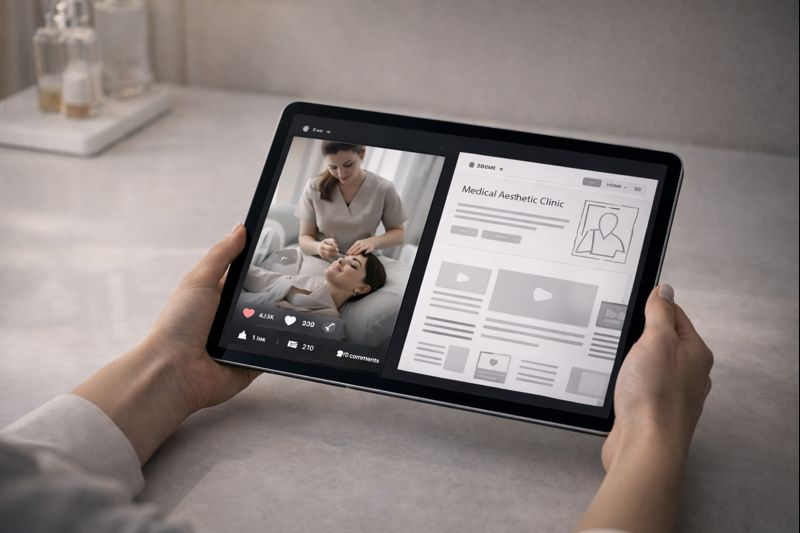
Many aesthetic clinic websites are built to look polished — clean design, professional photography, an attractive logo — but fail to convert visitors into booked consultations at the rate they should. The gap usually isn't aesthetic; it's structural. A beautiful website with confusing navigation, slow load times, or unclear calls to action will consistently underperform a less polished site that's built around how patients actually make booking decisions.
This guide focuses specifically on the conversion-oriented elements of aesthetic clinic website design — not visual branding alone, but the structural and functional decisions that determine whether a visitor becomes a consultation booking. For how website design fits into the broader marketing picture, see our Aesthetic Clinic Marketing pillar guide. For design and conversion support, explore our website design services.
Conversion Optimization: Designing for Decisions, Not Just Browsing
Conversion-oriented design starts from a simple premise: most visitors arrive with a specific question or intent (researching a treatment, comparing providers, checking pricing) and the website's job is to answer that question and provide a clear, low-friction next step.
Clear value proposition above the fold — Visitors should understand within seconds what the clinic specializes in and why they should consider it, without needing to scroll or dig through navigation.
Reducing decision fatigue — Pages with too many competing calls to action, excessive navigation options, or unclear hierarchy create friction that causes visitors to leave without acting. Each page should have a clear primary action.
Strategic use of social proof — Reviews, before-and-after galleries, and credentials placed near decision points (rather than buried on a separate "about" page) reinforce trust at the moment it matters most.
Progressive disclosure — Not every visitor needs every detail immediately; structuring pages so that essential information appears first, with additional depth available for visitors who want it, serves both quick-decision visitors and thorough researchers.
Mobile Design: Where Most Traffic Actually Happens
For most aesthetic clinics, the majority of website traffic — particularly from search and social media — arrives on mobile devices. A website that's designed primarily for desktop and merely "responsive" on mobile often falls short of what mobile-first design actually requires.
Tap target sizing — Buttons and links need to be appropriately sized and spaced for finger taps, not just mouse clicks; undersized tap targets are a common source of mobile frustration and abandonment.
Click-to-call prominence — Phone numbers should be tap-to-call enabled and prominently placed, since many mobile visitors prefer calling directly over filling out a form, particularly for higher-consideration treatments.
Simplified mobile navigation — Complex desktop navigation menus often translate poorly to mobile; a simplified mobile menu focused on the most important pages (treatments, booking, contact) tends to perform better than a complete mirror of desktop navigation.
Fast mobile load times — Mobile users are particularly sensitive to load time, and image-heavy pages (common for aesthetic clinics, given the importance of before-and-after content) need careful optimization to avoid sacrificing speed for visual quality.
Sticky or persistent booking CTA — A persistent, always-visible booking button (often fixed to the bottom of the screen on mobile) keeps the primary action accessible regardless of how far a visitor has scrolled.
Treatment Pages: Built to Convert, Not Just Inform
Treatment pages serve a dual purpose — they need to rank well in search (as discussed in our SEO for Aesthetic Clinics guide) and convert the visitors who land on them. These goals are complementary, not competing, but the conversion elements need deliberate attention.
Clear next step throughout — Rather than a single call to action at the bottom of a long page, multiple, well-placed CTAs throughout the content ensure visitors can act whenever they're ready, not just after reading the entire page.
Visual proof near the top — Before-and-after content or key result imagery placed early on the page (rather than requiring extensive scrolling) helps visually-driven decisions happen faster.
Pricing transparency — Even a price range, presented clearly, reduces the friction of visitors who would otherwise need to call or message just to get basic pricing information — and helps pre-qualify visitors before they reach the consultation stage.
Provider credibility — Information about who performs the treatment, prominently featured rather than buried in a separate bio page, supports the trust decision specific to that treatment.
Booking Funnels: Minimizing Friction From Click to Confirmed Appointment
The booking process itself is often an overlooked conversion point — a visitor who's decided to book can still be lost if the booking process is confusing, slow, or requires too much effort.
Minimal required fields — Booking or consultation request forms should require only the essential information needed for follow-up (typically name, phone, treatment of interest), with additional details collected during the actual follow-up conversation rather than the initial form.
Multiple booking pathways — Offering both a form-based option and a direct phone/call option accommodates different visitor preferences rather than forcing everyone through a single funnel.
Real-time availability where possible — If booking software supports it, showing actual available appointment times (rather than a generic "request a consultation" form with no visibility into scheduling) can increase completion rates by giving visitors a concrete sense of when they'll be seen.
Confirmation and expectation-setting — Immediate confirmation (whether automated or human) after a booking request, along with clear information about what happens next, reduces the anxiety and uncertainty that can lead to no-shows or abandoned bookings.
Trust Signals: Building Credibility Throughout the Site
Aesthetic treatments involve a degree of vulnerability and risk perception that makes trust signals particularly important compared to many other types of businesses.
Credentials and certifications — Prominently displaying relevant medical credentials, certifications, and provider qualifications addresses the legitimate concern patients have about who is performing their treatment.
Review integration — Rather than linking out to a separate reviews page, integrating actual review content (with appropriate attribution) directly into key pages reinforces trust without requiring visitors to leave the site to verify it.
Before-and-after galleries — With proper patient consent, comprehensive before-and-after galleries (organized by treatment) serve as some of the most persuasive trust-building content available to an aesthetic clinic.
Transparency about the consultation process — Clearly explaining what happens during a consultation (rather than leaving it ambiguous) reduces the anxiety that can prevent hesitant visitors from booking.
Professional, current photography — Outdated or low-quality photography of the clinic space and staff can undermine trust even when the actual practice is excellent; investing in current, professional photography pays dividends across the entire site.
Common Website Design Mistakes Aesthetic Clinics Make
Prioritizing aesthetics over function — A visually striking website that's confusing to navigate or slow to load will underperform a simpler, faster, more functional site.
Burying pricing information — Forcing every visitor to call or message just to learn basic pricing creates unnecessary friction and filters out visitors who would have converted with more transparency.
Generic stock photography — Undermines the authenticity and trust that aesthetic clinic patients are specifically looking for when evaluating providers.
Single, buried call to action — Pages with only one CTA, placed at the very bottom, miss the visitors who are ready to act earlier in their page visit.
Slow load times from unoptimized images — Particularly damaging for aesthetic clinics, since image-heavy before-and-after content is essential but often improperly optimized for web performance.
Desktop-first design thinking — Given how much traffic arrives on mobile, designing primarily for desktop and treating mobile as an afterthought consistently underperforms a mobile-first approach.
Frequently Asked Questions
How important is website design compared to marketing channels like SEO and paid ads?
Extremely important, since website design determines what percentage of the traffic generated by SEO and paid advertising actually converts into leads. A website with poor conversion design can undermine otherwise effective marketing efforts.
Should pricing be listed on an aesthetic clinic website?
Generally yes, even as a range. Pricing transparency reduces friction and helps pre-qualify visitors, though some clinics choose to provide ranges rather than exact figures given that pricing can vary by individual consultation.
How many calls to action should a treatment page have?
Multiple, strategically placed throughout the page — not just one at the very bottom — to capture visitors who are ready to act at different points in their reading.
Is mobile design really that much more important than desktop?
For most aesthetic clinics, the majority of traffic, particularly from search and social, arrives via mobile, making mobile experience design a priority rather than an afterthought.
What's the biggest website mistake aesthetic clinics make?
Prioritizing visual polish over functional conversion design — a website can look beautiful and still underperform significantly if navigation, load time, or calls to action aren't built around how patients actually make decisions.
Should before-and-after photos be on the homepage or only on treatment pages?
Both, generally. The homepage benefits from a strong visual proof point to establish credibility immediately, while treatment-specific before-and-afters on individual pages support the decision for that specific treatment.
How does website design affect SEO performance?
Significantly — site speed, mobile usability, and clear site structure are all factors that affect search rankings, meaning conversion-focused design and SEO-focused design overlap substantially rather than being separate concerns.
Your website should act as the conversion hub for the entire aesthetic clinic marketing system, turning traffic from search, Maps, Instagram, and paid campaigns into booked consultations.
Website conversion should be planned alongside Google Ads for aesthetic clinics, med spa lead generation, and local visibility assets such as your Google Business Profile for aesthetic clinics.
Ready to Turn Your Website Into a Conversion Engine?
A website that looks professional but doesn't convert is a missed opportunity that compounds across every marketing channel driving traffic to it. Book a growth audit with Powerhouse Media to identify exactly where your website is losing potential patients and how to fix it.
Aesthetic Clinic Marketing Cluster
Build the full patient acquisition system
Ready to apply this to your brand?
We partner with brands looking to scale profitably.
Apply for a strategy call