Meta Ads for Aesthetic Clinics: Targeting, Policies and Patient Leads
Build better Facebook and Instagram campaigns for aesthetic clinics with practical guidance on targeting, creative, policies, retargeting, and consultation funnels.
Why Meta Ads Play a Different Role Than Google Ads
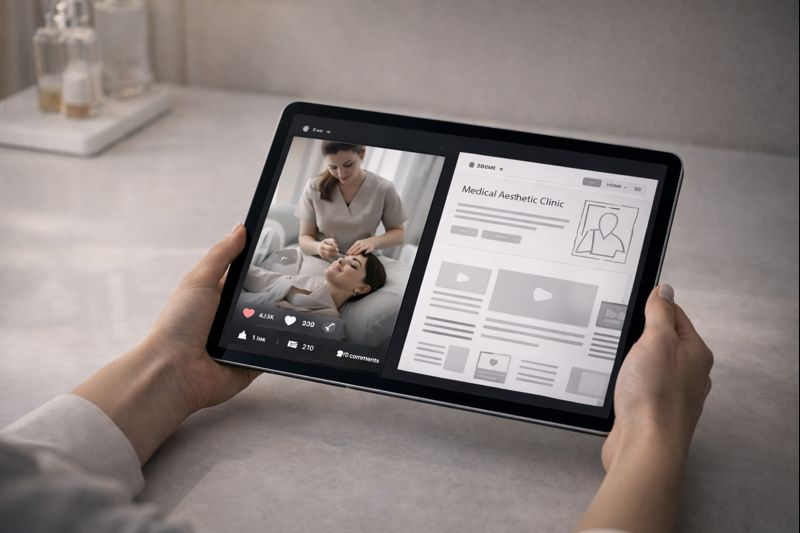
Where Google Ads captures people actively searching for treatments, Meta Ads (Facebook and Instagram) work differently — they create demand by reaching people who aren't necessarily searching yet, but who fit the profile of someone likely to be interested in aesthetic treatments. This is often described as the difference between "intent-based" and "interest-based" advertising.
For aesthetic clinics, this distinction matters enormously. Meta's visual format is uniquely suited to the aesthetic industry — before-and-after results, treatment videos, and patient testimonials perform exceptionally well in a way that text-based search ads simply cannot replicate. A scroll-stopping before-and-after video can introduce a potential patient to a treatment they didn't know they wanted, well before they'd ever think to search for it on Google.
This makes Meta Ads a powerful complement to search advertising, particularly for treatments that benefit from visual demonstration — body contouring, skin resurfacing, injectables results, and transformation-style treatments. Clinics that need campaign strategy and implementation can explore our performance marketing services. For a full view of how Meta fits into a broader strategy, see our Aesthetic Clinic Marketing pillar guide.
Lead Generation Campaigns: Reducing Friction to Book
One of the most effective campaign types for aesthetic clinics on Meta is the lead generation campaign, particularly Meta's native lead forms. These forms open directly within the Facebook or Instagram app, pre-fill the user's contact information, and require no page load — dramatically reducing the friction compared to sending traffic to an external website.
The tradeoff is lead quality. Native lead forms tend to generate a higher volume of leads, but some will be lower intent — people who tapped through with minimal consideration. This isn't necessarily a problem if your clinic has a strong follow-up process; it simply means the qualification step shifts from the ad click to the phone call or message that follows.
For clinics with a dedicated team to follow up quickly (ideally within minutes, not hours), native lead forms can generate excellent volume. For clinics without strong follow-up capacity, sending traffic to a dedicated landing page — slower but typically higher-intent — may produce better results.
Creative Strategy: What Actually Performs
Creative is the single biggest performance lever in Meta advertising — often more impactful than targeting or budget decisions. For aesthetic clinics, a few creative formats consistently outperform others:
Before-and-after content — When used with proper patient consent and in compliance with platform policies, before-and-after visuals remain among the highest-performing creative formats in the industry.
Procedure or treatment-room video — Short videos showing the treatment environment, equipment, or a (non-graphic) glimpse of the process help demystify treatments and build trust.
Patient testimonial videos — Authentic, unscripted-feeling testimonials tend to outperform polished, scripted ones.
Provider-led educational content — Short videos of providers explaining a treatment, addressing a common concern, or busting a myth perform well both as ads and as organic content that can be boosted.
UGC-style content — User-generated-content style creative (filmed on a phone, casual framing) often outperforms highly produced content because it feels native to the platform rather than like an ad.
A practical approach is to maintain a continuous content production cadence — even simple phone-shot content — rather than relying on occasional, highly produced campaigns. Meta's algorithm rewards creative variety and tends to fatigue quickly on a small number of ads, regardless of production quality.
Before-and-After Ads: Navigating Platform Policies
Before-and-after content is highly effective but also closely scrutinized by Meta's advertising policies, particularly around health and wellness claims. Clinics should be aware that:
- Ads cannot make implied health claims that go beyond what's substantiated
- Content depicting "idealized" body image in certain contexts may be restricted, particularly for body contouring or weight-related treatments
- Before-and-after content should focus on the treatment and results rather than implying guaranteed outcomes for all patients
Working within these guidelines isn't just about avoiding ad disapprovals — it's also about building a brand that feels trustworthy rather than making the kind of exaggerated claims that erode patient trust over time.
Retargeting: Capturing the Patients Who Almost Booked
Most people who interact with an aesthetic clinic's ads or website won't book a consultation on their first visit — and that's normal. Retargeting campaigns re-engage these warm audiences with different messaging than the initial cold campaign.
Effective retargeting segments for aesthetic clinics typically include:
Website visitors who didn't convert — Particularly those who visited a treatment page or pricing page but didn't submit a form.
Video viewers — People who watched a significant portion of a video ad but didn't click through, indicating interest without action.
Lead form openers who didn't submit — People who engaged with a lead form but abandoned it before completing.
Past consultation no-shows — With appropriate privacy considerations, re-engaging people who booked but didn't attend can recover otherwise-lost leads.
Retargeting messaging should differ from cold campaign messaging — rather than introducing the treatment, it might address a common objection, offer a limited-time incentive, or feature a different testimonial that speaks to hesitation.
Audience Targeting: Building on Meta's Strengths
Meta's targeting capabilities have shifted significantly toward broad, algorithm-driven targeting rather than highly granular manual interest stacking. For most aesthetic clinics, this means:
Broad targeting with strong creative — Rather than narrowly defining audiences by dozens of interests, providing Meta's algorithm with strong conversion signals (via the pixel and conversions API) and letting it find relevant audiences within a broad geographic and demographic range often outperforms highly restrictive targeting.
Geographic targeting remains essential — Since patients need to physically visit the clinic, a tightly defined geographic radius around the practice location is one of the few targeting parameters that should remain restrictive.
Lookalike audiences — Built from existing patient lists or website conversion data, lookalike audiences can help identify new potential patients who share characteristics with existing ones.
Age and demographic targeting — Should reflect the realistic patient profile for specific treatments rather than overly broad assumptions — but shouldn't be so narrow that it limits the algorithm's ability to find qualified prospects.
Set the catchment area around real patient travel behavior
Local targeting should reflect how far patients realistically travel for the treatment, not an arbitrary city-wide setting. Start with the clinic's true service area, exclude locations the team cannot serve, and compare successful form submissions by area before expanding. In dense markets, including cities such as Bangkok, a small radius can still contain very different neighborhoods, travel times, income profiles, and treatment demand. Separate those areas only when the budget and lead volume are sufficient to evaluate them responsibly.
Avoid changing geography, creative, audience, and offer at the same time. Keep enough of the campaign stable to identify whether an improvement came from location quality or another variable. The useful outcome is not the cheapest click; it is a successful, relevant consultation form from a patient the clinic can serve.
Consultation Funnels: From Ad to Appointment
The path from seeing an ad to sitting in a consultation chair involves several steps, and each one represents a potential drop-off point. A well-designed consultation funnel minimizes friction at each stage:
Step 1: Ad engagement — The creative captures attention and communicates a clear value proposition.
Step 2: Lead capture — Whether through a native lead form or landing page, this step should require minimal information — typically just name, phone, and the treatment of interest.
Step 3: Immediate follow-up — Speed matters enormously here. Leads contacted within minutes convert at significantly higher rates than those contacted hours later.
Step 4: Consultation booking — Ideally, this happens during the first follow-up contact, with the consultation booked on the spot rather than left as an open-ended "we'll call you back."
Step 5: Reminder sequence — Automated reminders (SMS and email) in the days leading up to the consultation reduce no-show rates significantly.
Each of these steps can be measured and optimized independently. A clinic with excellent ad performance but poor follow-up speed will see disappointing results despite a technically successful campaign — the issue isn't the ads, it's the funnel.
Bringing Meta Ads Together With Your Overall Strategy
Meta Ads work best as part of an integrated approach — generating awareness and interest that complements the high-intent capture of Google Ads and the long-term visibility of SEO. For a complete framework on how these channels work together, see our Aesthetic Clinic Marketing pillar guide and our Google Ads for Aesthetic Clinics guide.
Frequently Asked Questions
Should my clinic use Facebook, Instagram, or both?
Both platforms run through the same Meta Ads system, and campaigns can target both simultaneously. Instagram tends to skew toward a younger demographic and performs particularly well for visually-driven content, while Facebook often reaches a broader age range. Most aesthetic clinics benefit from running across both.
Are before-and-after photos allowed in Meta ads?
Generally yes, with patient consent and within Meta's advertising policies around health claims and body image content. Policies are reviewed periodically, so creative should be checked against current guidelines before launch.
How much budget do I need for Meta Ads as an aesthetic clinic?
Budget needs vary by market and goals, but campaigns generally perform better with consistent, ongoing spend that allows the algorithm to optimize, rather than short bursts of high spend followed by pauses.
What's the difference between lead generation ads and traffic ads?
Lead generation ads use native forms that open within the platform, reducing friction but sometimes lowering lead quality. Traffic ads send users to your website or landing page, which can produce higher-intent leads but with more drop-off.
How important is video versus static image content?
Video, particularly short-form vertical video, tends to perform very well for aesthetic clinics, especially for treatments that benefit from visual demonstration. However, high-performing static images and carousel ads still have a role, particularly for retargeting and testimonial content.
How do I avoid having my ads disapproved?
Avoid making explicit health claims about guaranteed results, ensure before-and-after content complies with current platform policies, and be mindful of language around body image, particularly for body contouring treatments.
How does retargeting work if I have a small audience?
Even smaller clinics typically generate enough website traffic and ad engagement over a month or two to build a viable retargeting audience, though it may take slightly longer to reach optimal audience sizes for algorithm optimization.
For clinics using Meta to support treatment demand, this strategy should connect with Instagram marketing for injectables, med spa lead generation, and treatment-specific campaigns such as Botox marketing strategies.
Turn Meta attention into booked consultations
Meta Ads perform best when creative, targeting, lead capture, and follow-up operate as one system. We can help you identify the campaign and funnel changes most likely to improve qualified patient demand.
Aesthetic Clinic Marketing Cluster
Build the full patient acquisition system
Ready to apply this to your brand?
We partner with brands looking to scale profitably.
Apply for a strategy call