Fashion Forward Google Ads Case Study: 10.2x ROAS on $823K Spend
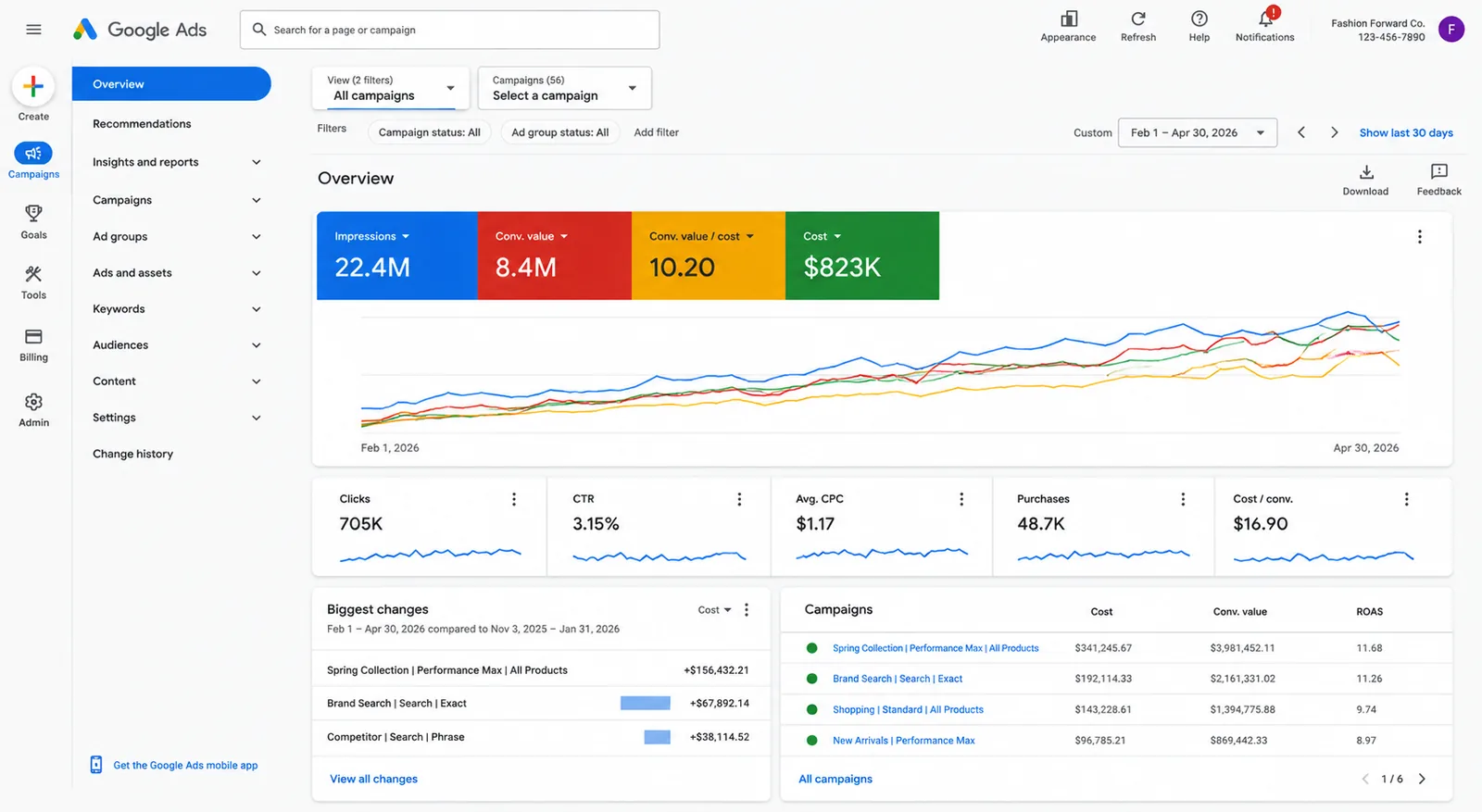
Fashion Forward Co. needed profitable scale, not just more traffic. The brand was spending aggressively, but its paid search account had drifted into the common ecommerce problem: too much budget flowing through broad campaign structures, too little control over product-level intent, and creative assets that were no longer giving the algorithm strong buying signals.
This case study shows how Powerhouse Media rebuilt the account into a more disciplined performance marketing system across Performance Max, Shopping, brand search, and landing page testing.
The Challenge
The brand had demand, inventory, and an audience. What it did not have was a clean paid media architecture. Shopping campaigns were spending into low-intent queries, the Performance Max setup treated too many products as one undifferentiated feed, and creative was not being refreshed in a way that supported learning.
As spend increased, efficiency decreased. That is a dangerous pattern for ecommerce teams because it creates the illusion that budget is the problem, when the real issue is structure. Scaling an inefficient account simply makes the waste larger.
What We Did
We rebuilt the Google Ads account around product collection logic. Instead of forcing the algorithm to interpret a broad product dump, we segmented campaigns by collection, margin profile, and buying intent.
- Performance Max segmentation: Campaigns were rebuilt by collection so budget could move toward the product groups producing stronger return.
- Creative asset refresh: New visual assets were added to give the system stronger signals across placements.
- Shopping feed cleanup: Product titles, attributes, and weak terms were tightened to reduce irrelevant spend.
- Brand search protection: Exact-match brand campaigns captured the highest-converting demand without letting PMax overclaim every result.
- Landing page testing: A/B tests ran in parallel so paid traffic had a clearer path from click to purchase.
The key was not one clever campaign setting. It was aligning campaign structure, product feed quality, creative assets, and landing page relevance into one measurable system.
The Result
In 90 days, the account generated $8.4M in conversion value from $823K in ad spend, producing a 10.2x ROAS. The top Spring Collection Performance Max campaign reached 11.68 ROAS on its own.
- $823K total spend
- $8.4M conversion value
- 48.7K purchases
- $16.90 average CPA
- $1.17 average CPC
Why It Worked
The account improved because the media buying became more specific. Ecommerce campaigns perform better when the platform can understand what product group it is optimizing, which audience signal matters, which creative assets support the sale, and which landing page should receive the traffic.
This is the same principle behind our broader profit-first ecommerce scaling approach: scale only becomes meaningful when the unit economics are protected.
What Other Ecommerce Brands Can Learn
If Performance Max is underperforming, do not assume the campaign type is broken. Audit the product feed, asset quality, campaign segmentation, brand search protection, and post-click path first. Most ecommerce accounts do not need more budget before they need more clarity.
Frequently Asked Questions
What was the biggest lever in this ecommerce Google Ads case study?
The biggest lever was restructuring Performance Max around cleaner product collection logic and supporting it with better Shopping feed hygiene.
Did the results come from Performance Max alone?
No. Performance Max was important, but the result came from the full system: Shopping feed cleanup, brand search protection, creative assets, and landing page testing.
Can this approach work for smaller ecommerce brands?
Yes, but the budget and campaign structure should match the brand's available conversion volume. Smaller stores usually need fewer campaigns and tighter product priorities.
Where should ecommerce brands start?
Start by auditing where spend is going by product group, query intent, campaign type, and landing page. That reveals whether the issue is traffic quality, conversion rate, or product economics.
Build a More Measurable Paid Media System
If your ecommerce account is spending but not scaling profitably, Powerhouse Media can audit the campaign structure, tracking, feed, and landing pages. Start with our Performance Marketing Services.
Related Insights
Continue exploring Case Studies
Ready to apply this to your brand?
We partner with brands looking to scale profitably.
Apply for a strategy call