High-Converting Roofing Websites: How to Turn Visitors into Calls and Estimates
Introduction
A roofing website isn't a digital business card. It's the page every SEO click, every Google Ad, and every referral search eventually lands on — and if it doesn't turn that visit into a call, form, or estimate request, everything upstream of it is being wasted.
For the complete acquisition framework, see our roofing marketing strategy pillar guide.
Most roofing websites weren't actually built to convert. They were built to look professional. This guide covers what separates a roofing website that generates booked estimates from one that just sits there looking fine, including the pages you need, the CRO fundamentals that matter most, and the mistakes that quietly cost leads.
For a complete breakdown of SEO, Google Ads, website design, CRO, and follow-up systems, read our full guide to digital marketing for roofing contractors.
Why Most Roofing Websites Don't Convert
Common issues that quietly suppress conversion rates:
- A weak or generic homepage headline that doesn't say what you do or where you serve
- No clear, repeated call to action
- Slow load times on mobile, where most local searches happen
- No trust signals — reviews, licensing, insurance, years in business
- Missing or thin service pages
- No dedicated path for emergency or urgent inquiries
- Long, complicated forms
- No tracking, so there's no visibility into what's actually converting
None of these are dramatic problems individually. Together, they're usually the reason a roofing website gets traffic but not leads.
What Makes a Roofing Website High-Converting?
The fundamentals that consistently move the needle:
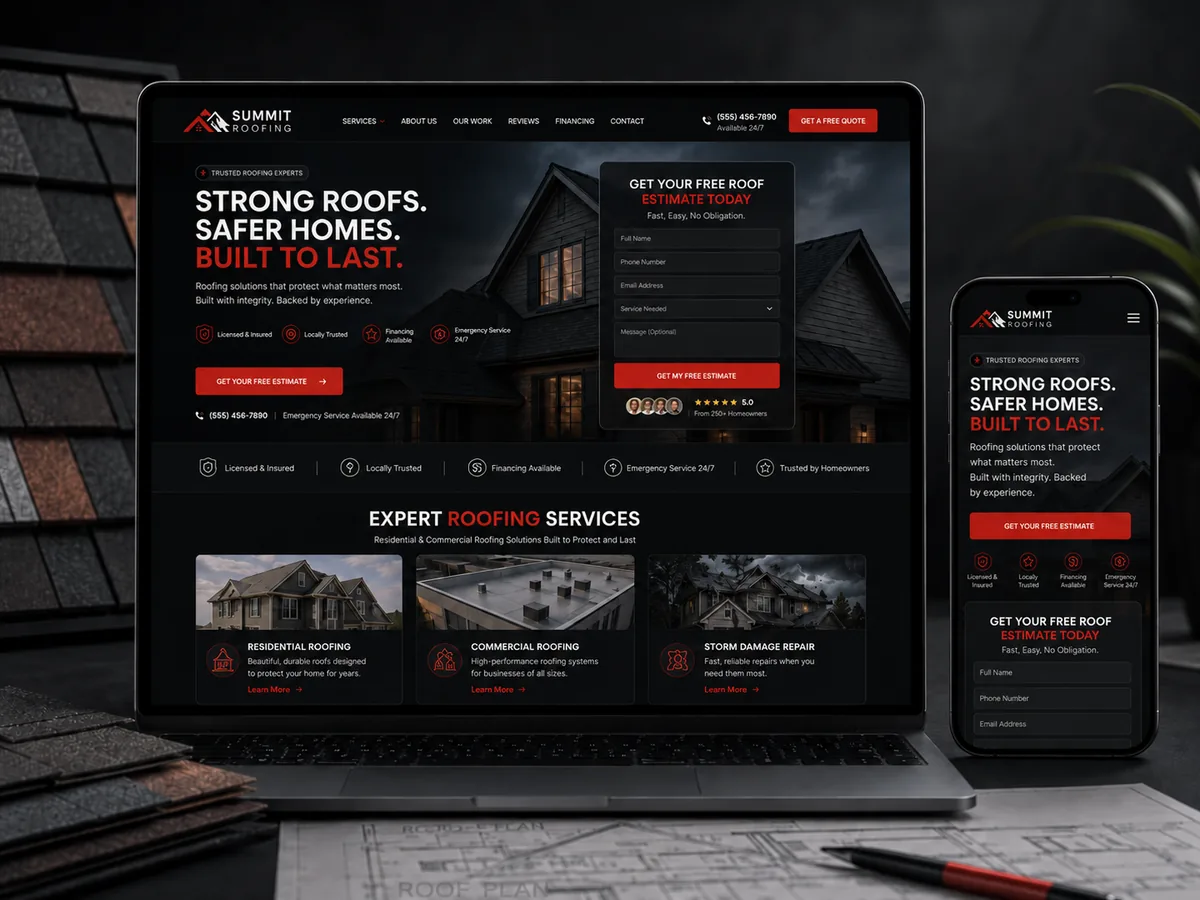
- Clear positioning — what you do, who you serve, and where, visible immediately
- Click-to-call — a phone number that's tappable on every page, especially mobile
- A simple estimate request form — short, with only essential fields
- Trust badges — licensing, insurance, association memberships, Google Guaranteed if applicable
- Reviews — visible on the homepage and service pages, not buried on a separate page
- Real project photos — before/after shots from actual jobs, not stock imagery
- Financing information, if you offer it — often a deciding factor for large jobs like full replacements
- Service-specific pages — not one general "services" page trying to cover everything
- Fast mobile performance — page speed directly affects both rankings and conversion rates
Roofing Website Homepage Checklist
- ear headline stating service and service area
- one number visible and clickable in the header
- imary CTA above the fold (call or request estimate)
- views or star rating visible near the top
- otos of real completed work
- nks to core service pages
- ust signals (licensed, insured, years in business)
- bile page speed under a few seconds
- ergency/urgent contact path clearly visible
- oter with service areas, license number, and contact info
Service Pages Every Roofing Website Should Have
Dedicated pages consistently outperform a single generic services page, both for SEO and for conversion — visitors searching for a specific need land on content written specifically for it.
- Roof repair
- Roof replacement
- Storm damage repair
- Hail damage repair
- Emergency roof tarping
- Metal roofing
- Commercial roofing
- Flat roofing
- TPO roofing
- Roof coatings
Each page should include what the service involves, signs a homeowner needs it, relevant photos, and a clear call to action — not a rewritten version of the homepage with a different title.
Landing Pages for Roofing Ads
Website pages and landing pages serve different purposes. A website service page is built for SEO and general visitors researching a topic. A landing page is built for a specific ad campaign — stripped of navigation and distractions, focused entirely on one action.
Sending Google Ads or LSA traffic to a general homepage instead of a dedicated landing page is one of the most common reasons paid campaigns underperform. A storm damage ad, for example, should land on a storm damage-specific page with matching messaging, not a generic homepage the visitor has to search through.
CRO for Roofing Companies
Conversion rate optimization (CRO) is the practice of improving the percentage of visitors who take action — without needing more traffic. For roofing websites, the highest-impact areas are usually:
- Headlines that immediately communicate service and location
- CTA placement — repeated at logical points, not just once at the bottom
- Form fields — every unnecessary field reduces completion rate
- Trust elements — reviews, licensing, and insurance near decision points
- Mobile speed — since most roofing searches happen on a phone, often urgently
- Before/after proof — visual evidence tends to outperform written claims
- Tracking — without it, you're optimizing based on guesses instead of data
Roofing Website Design Mistakes to Avoid
- Relying heavily on stock photography instead of real project photos
- No service area or location pages for multi-city coverage
- No visible proof — reviews, photos, credentials
- No distinct path for emergency or urgent inquiries
- Generic, one-size-fits-all contact forms
- No tracking or analytics in place
- Slow-loading pages, especially on mobile
How Powerhouse Media Builds Roofing Websites
Powerhouse Media designs roofing websites around conversion first — structured for SEO, built with dedicated service and landing pages, backed by call tracking and analytics, and optimized for fast mobile performance so traffic from every channel has a real chance of converting.
Your roofing website should turn visitors into calls and estimate requests. Book a free website conversion audit and we'll show you what may be costing you leads.
Frequently Asked Questions
What should a roofing website include?
Clear positioning, click-to-call, an estimate request form, trust signals, reviews, real project photos, and dedicated pages for each core service.
How much does a roofing website matter for leads?
Significantly. It's the destination for nearly every marketing channel — SEO, Google Ads, LSAs, and referrals — so conversion issues on the website suppress the return from every one of them.
Do roofers need separate landing pages for Google Ads?
In most cases, yes. Dedicated landing pages matched to the ad's specific service tend to convert better than sending traffic to a general homepage.
What makes a roofing website convert better?
Clear calls to action, fast mobile performance, visible trust signals like reviews and licensing, and simple, low-friction forms.
Should roofing companies use templates or custom websites?
Either can work if it's fast, mobile-optimized, and built around conversion. The template itself matters less than whether the structure and content are done correctly.
How many pages should a roofing website have?
At minimum, a dedicated page for each core service plus location pages for every area served — a single general services page is usually not enough for either SEO or conversion.
Book a Free Roofing Website Conversion Audit
If your roofing company wants more qualified calls, booked estimates, and a stronger lead follow-up system, Powerhouse Media can help build the full growth engine — SEO, Google Ads, website design, CRO, AI appointment setting, missed-call recovery, and reporting.
Book a Free Website Conversion Audit
Related Roofing Marketing Resources
Connect this guide to the complete roofing contractor marketing system and the relevant Website Design Services.
Roofing Marketing Cluster
Build the complete roofing lead system
Ready to apply this to your brand?
We partner with brands looking to scale profitably.
Apply for a strategy call